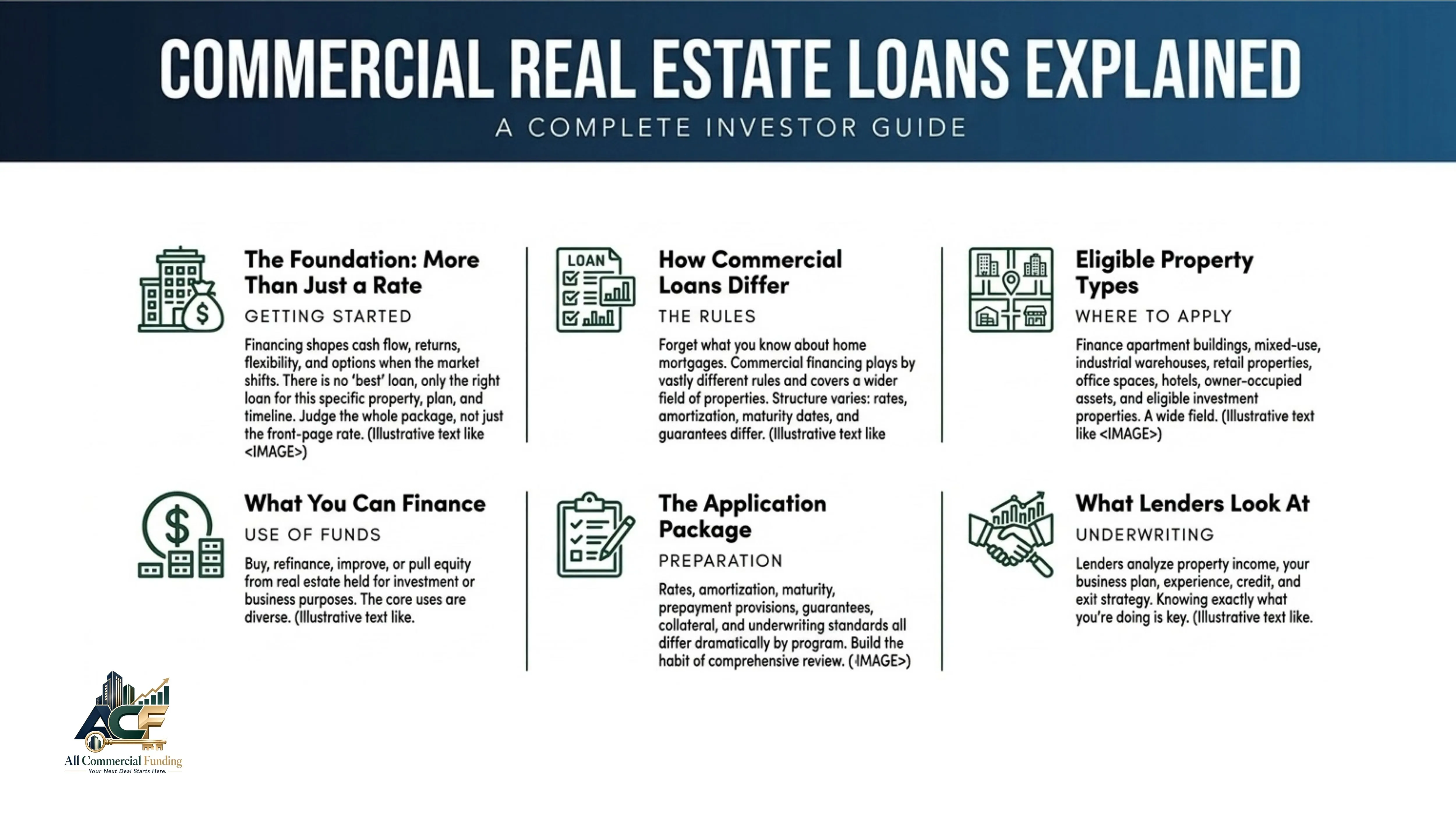
Commercial Real Estate Loans Explained: Complete Investor Guide
You found the deal. Now comes the part that decides whether it actually makes you money.
Financing is where good properties turn into great investments, or into headaches you're stuck with for the next five years. The loan you choose shapes your cash flow, your returns, your flexibility, and your options when the market shifts.
Here's the thing most investors learn the hard way: there is no "best" commercial loan. There's only the right loan for this property, this business plan, this timeline, and this exit.
This guide walks you through how commercial real estate loans actually work, what your options are, what lenders are really looking at, and how to walk into a financing conversation knowing exactly what you're doing.
What Is a Commercial Real Estate Loan?
Simple version: it's financing used to buy, refinance, improve, or pull equity from real estate held for investment or business purposes.
Forget what you know about getting a home mortgage. Commercial financing plays by different rules and covers a much wider field. Depending on the lender and the program, you may be able to finance:
Apartment buildings and multifamily properties
Mixed-use properties
Industrial buildings and warehouses
Retail properties
Office and flex space
Hotels and hospitality properties
Owner-occupied commercial properties
Specialty-purpose properties
Investment properties, including eligible residential assets
The structure is different too. Rates, amortization schedules, maturity dates, prepayment provisions, guarantees, collateral requirements, underwriting standards. All of it varies from program to program, sometimes dramatically.
Which leads to the single most valuable habit you can build as a commercial borrower: judge the whole package, never just the rate on the front page.
How Do Commercial Real Estate Loans Work?
The basic mechanics are familiar. A lender funds a percentage of the capital you need. You bring the rest as equity. You repay on the agreed terms.
What's not familiar is how differently lenders size up the same deal.
Depending on the program, underwriting may zero in on:
Property cash flow. Does the property earn enough to carry its own debt?
Loan-to-value or loan-to-cost. How much debt are you asking for against the value or the total project cost?
Borrower experience. Have you owned, managed, renovated, or developed something like this before?
Credit and financial strength. What does your financial picture look like on paper?
Property condition. Is the asset stabilized, vacant, distressed, mid-renovation, or changing use?
Business plan. Are you holding, improving, leasing up, refinancing, or selling?
Exit strategy. With short-term money especially: how does this debt get paid off?
One lender weighs cash flow heaviest. Another cares most about your track record. A third looks straight at the collateral. Knowing which is which saves you weeks.
Major Types of Commercial Real Estate Loans
There's no universal "commercial mortgage." There are lanes. Find yours.
1. DSCR Loans
DSCR financing is built around one question: can the property cover its own debt payments?
The math is straightforward:
DSCR = Net Operating Income ÷ Annual Debt Service
Say a property produces $150,000 in qualifying net operating income and carries $120,000 in annual debt service. That's a 1.25x DSCR.
Why investors like these loans: underwriting can lean on the property's cash flow instead of leaning primarily on your personal income. Your W-2, your tax write-offs, your day job — often not the center of the conversation.
That makes DSCR a workhorse for investors building rental portfolios or buying income-producing assets where the numbers speak for themselves.
2. SBA 7(a) Loans
SBA 7(a) money can work for qualifying businesses that need capital for real estate acquisition, buying a business, expansion, equipment, or working capital.
One critical caveat for investors: SBA programs are generally designed for eligible operating businesses, not passive real estate investment.
So if you're a business owner who wants to buy the building you operate out of, this is a program worth a serious look. If you're buying a rental, look elsewhere.
3. SBA 504 Loans
SBA 504 is the program most associated with major fixed assets — owner-occupied commercial real estate and equipment.
The structure involves multiple parties, typically a participating lender and a Certified Development Company.
More moving pieces, yes. But for an eligible business buying or improving the property it occupies, 504 can deliver a long-term capital structure that's hard to beat.
4. Bridge Loans
Bridge loans exist for two situations: you need to move fast, or the property isn't ready for conventional long-term debt yet.
Bridge financing may be worth exploring when:
The property needs substantial renovation
Occupancy has to be improved
Leases need to be stabilized
Your closing deadline is brutally short
Conventional financing can't hit the timeline
You plan to refinance once the value-add plan is executed
Bridge money is temporary by design. That makes your exit strategy the whole ballgame. Know how you're getting out before you get in.
5. Hard Money Loans
Hard money is asset-focused, short-term capital from private lenders.
It fits deals where speed, collateral value, or the property's future potential matters more than checking every box at a bank.
Flippers and value-add investors use it to acquire and renovate, then sell or refinance into longer-term debt.
The tradeoff is real: borrowing costs can run higher than conventional financing. That puts pressure on your timeline and your projected return. Fast money is only smart money when the project actually moves fast.
6. Portfolio Loans
Portfolio lenders keep loans on their own books instead of structuring them for sale into a standardized secondary market program.
Translation: they write their own rules. That means portfolio financing can sometimes accommodate a property or a borrower that conventional guidelines would kick out.
If you own multiple properties, hold an unusual asset, or have a genuinely complicated situation, this flexibility can be exactly what you need.
7. Bank and Conventional Commercial Loans
Banks still matter, especially for stabilized properties and financially strong borrowers.
Terms can be very competitive. The cost of admission is usually detailed underwriting, thorough financial documentation, borrower guarantees, sometimes a deposit relationship or other institution-specific requirements.
One caution: don't assume the bank you've always used is automatically your best deal. Compare the full structure, then decide.
8. Agency and CMBS Financing
Larger or stabilized properties may qualify for institutional capital through agency programs or commercial mortgage-backed securities (CMBS) loans.
The upside can be significant: loan size, amortization structure, and non-recourse availability.
The cost of that upside is complexity. Expect more involved underwriting, prepayment restrictions, servicing requirements, and minimum transaction sizes.
Recourse vs. Non-Recourse Commercial Loans
This distinction affects your personal risk more than almost anything else in the loan documents.
With a recourse loan, you or your guarantor may be personally responsible for repayment beyond the collateral, subject to what the loan documents say.
With a non-recourse loan, the lender generally looks primarily to the financed property for repayment in a default. But read carefully: non-recourse financing commonly includes exceptions, sometimes called "bad-boy carve-outs," covering things like fraud or other prohibited conduct.
Non-recourse is appealing if you're trying to limit personal exposure. Whether it's available depends on the property, the leverage, the borrower, the loan size, and the lender.
Ask early. Don't discover the answer at closing.
Understanding LTV, LTC, and DSCR
Three numbers come up in nearly every commercial conversation. Learn them and you'll follow the whole discussion.
Loan-to-Value (LTV)
LTV compares your loan amount to the property's value.
LTV = Loan Amount ÷ Property Value
A $700,000 loan on a property valued at $1 million is 70% LTV.
Lower leverage means more of your equity in the deal and less exposure for the lender.
Loan-to-Cost (LTC)
LTC is the number that matters on renovation, construction, and value-add projects.
LTC = Loan Amount ÷ Total Project Cost
If your total acquisition plus renovation cost is $2 million and the loan is $1.5 million, that's 75% LTC.
Debt Service Coverage Ratio (DSCR)
DSCR measures whether the property can cover its required debt payments.
Above 1.00x generally means qualifying property income exceeds the measured debt service. Just remember that minimum requirements and calculation methods vary by lender and program.
Run these three numbers on your own deal before you apply anywhere. You'll know roughly how a lender is going to see it, and you'll stop wasting time on programs that were never going to work.
Fixed vs. Variable Interest Rates
Commercial loans come both ways.
A fixed-rate loan gives you predictability. The rate stays fixed for the period specified in your loan terms, so you can model cash flow with confidence.
A variable-rate loan moves with an underlying benchmark plus the lender's spread. It can start lower. It can also climb.
Neither one wins automatically. The right answer depends on your expected holding period, your tolerance for rate risk, your refinancing plan, the property's cash flow cushion, and potential prepayment costs.
Keep this in mind: the lowest starting rate and the lowest total cost of capital are not the same thing.
Amortization Period vs. Loan Term
Two words that sound related and are not. Mixing them up creates real problems.
Amortization is the schedule used to calculate your principal payments.
Loan term or maturity is when the outstanding balance comes due.
A commercial loan can calculate payments on a long amortization schedule while maturing far sooner. When that happens, a balance may be sitting there waiting at maturity. You'll need to pay it off, sell, or refinance.
None of that is a problem if you planned for it. All of it is a problem if you didn't. Know your maturity date before you sign, not three years later.
How Much Down Payment Is Required?
There's no universal answer, and anyone who gives you one number for all of commercial real estate is guessing.
Required equity depends on the program, the property, the transaction, your profile, occupancy, cash flow, leverage, and the lender.
So stop asking only, "How much do I need down?" Start asking the better question:
What leverage is realistically available on this deal, and what does dialing leverage up or down do to my terms?
More leverage protects your cash but raises your debt service and your risk. Less leverage can open up better financing options but demands more money at closing.
There's no universally correct answer. There's only the one that fits what you're trying to accomplish.
Why Investors Work With Commercial Mortgage Brokers
Commercial lending is a fragmented market, and that fragmentation costs uninformed borrowers real money.
Banks, private lenders, SBA lenders, DSCR lenders, bridge lenders, agency programs, portfolio lenders, institutional capital. Every one of them has a different credit box. A deal that's a hard "no" at one shop can be a straightforward "yes" at another.
A commercial mortgage broker helps you see options across multiple lending sources instead of betting your deal on one institution's appetite.
At All Commercial Funding, we work with real estate investors, house flippers, business owners, and commercial property owners across a wide range of asset classes and financing needs.
Our process is built to be simple:
Submit your scenario. Tell us about the property, the transaction, and what you're trying to achieve.
We shop the deal. We evaluate appropriate lenders and programs and work to identify competitive terms for your scenario.
Move toward closing. Once you choose a financing option, the file moves through the lender's underwriting and closing process.
You get to compare more than one source of capital before you commit. That's the whole point.
Common Commercial Real Estate Financing Mistakes
A strong property can still turn into a rough investment when the financing doesn't fit. Here's where investors trip.
Shopping the rate and nothing else. Fees, amortization, maturity, prepayment penalties, recourse, reserves, closing costs, covenants, extension provisions. All of it affects what the loan actually costs you.
Starting the financing conversation too late. If your contract is nearly due and you're just now looking for capital, you've given up your leverage. Complex deals reward early lender conversations.
Assuming lenders calculate the same way. Income, DSCR, property value, leverage. Two lenders can look at identical documents and reach different numbers.
Taking short-term money without a defined exit. If the plan is to refinance, know exactly what has to be true before permanent financing becomes available. Hope is not an exit strategy.
Questions to Ask Before Accepting a Commercial Loan
Before you sign anything, understand the entire transaction.
Ask about the rate and whether it's fixed or variable. Then keep going: amortization period, maturity date, required equity, fees, closing costs, guarantees, reserves, prepayment provisions, extension options, lender conditions.
If it's bridge or transitional financing, ask what happens if the project runs long. It often does.
If it's long-term financing, ask what happens if you sell or refinance ahead of schedule.
Read the term sheet as a complete package. Never let it get reduced to one number.
Commercial Real Estate Loan FAQ
Can I get a commercial real estate loan without using my personal income?
Possibly. Certain investor programs, DSCR financing among them, can put greater emphasis on qualifying property cash flow. Eligibility and underwriting requirements vary by lender.
Can I refinance a commercial property and take cash out?
Cash-out commercial refinancing may be available when equity, cash flow, and lender requirements support the transaction.
What is a good DSCR for commercial real estate?
There's no single threshold across all lenders. Requirements shift with property type, program, leverage, market conditions, and underwriting standards.
How long does commercial real estate financing take?
It varies widely. Clean transactions with complete documentation can move quickly. SBA, institutional, construction, and complicated deals typically need more time.
Can I finance a property that needs renovation?
Yes. Bridge, hard money, construction, and certain value-add programs may be built for exactly that. The right structure depends on your scope of work and your exit.
Final Thoughts
Getting approved isn't the goal. Getting the right capital is.
The right loan fits the property, the strategy, the timeline, the cash flow, and where you want to be in five years. The wrong loan can quietly eat your returns while you make every payment on time.
Understand DSCR, leverage, recourse, amortization, maturity, and prepayment terms, and you stop being a borrower who takes what's offered. You become an investor who chooses.
Buying your next property, refinancing existing debt, pulling cash out, repositioning an asset, or racing a closing deadline? Comparing your options before you commit is one of the highest-return hours you'll spend on the deal.
Ready to see what your financing options look like?
All Commercial Funding offers a no-cost pre-approval process for real estate investors, house flippers, business owners, and commercial property owners. No SSN. No credit pull for the initial pre-approval.
Already holding a term sheet? Send it to us. We'll try to beat the rate by up to 0.25% on qualifying deals.
Start your no-cost pre-approval and find out what's available for your next deal.
This article is for general informational purposes only and does not constitute a commitment to lend, financial advice, legal advice, or a guarantee of financing. Loan programs, rates, terms, eligibility requirements, and availability vary by lender, borrower, property, and transaction.