DSCR Loans Explained: Qualify Without Personal Income (2026)
DSCR Loans Explained: How Real Estate Investors Qualify Without Income
You own rental properties. Your portfolio is growing. The cash is coming in.
Then you apply for a mortgage, and the lender stares at your tax return like it tells the whole story.
It doesn't.
Smart investors take legitimate deductions, write off depreciation, and reinvest profits back into their properties. That's how wealth gets built. But on paper, it can make your income look a lot smaller than your real financial position.
That's exactly why DSCR loans exist.
A Debt Service Coverage Ratio loan lets qualifying real estate investors get financing based primarily on the cash flow of the investment property, not traditional personal income qualification.
The lender stops asking, "How much does the borrower earn?" and starts asking a far better question:
Does this property generate enough income to support its debt?
Here's your complete guide to DSCR loans explained: how real estate investors qualify without income, what lenders look for, and what you need to know before applying in 2026.
What Is a DSCR Loan?
DSCR stands for Debt Service Coverage Ratio. It compares the income an investment property generates with the debt payments needed to finance it.
In commercial real estate underwriting, the Office of the Comptroller of the Currency defines DSCR as a property's net operating income divided by its annual debt service requirements, a measure of the property's ability to service its debt.
Read the OCC Commercial Real Estate Lending Handbook
The concept is refreshingly simple:
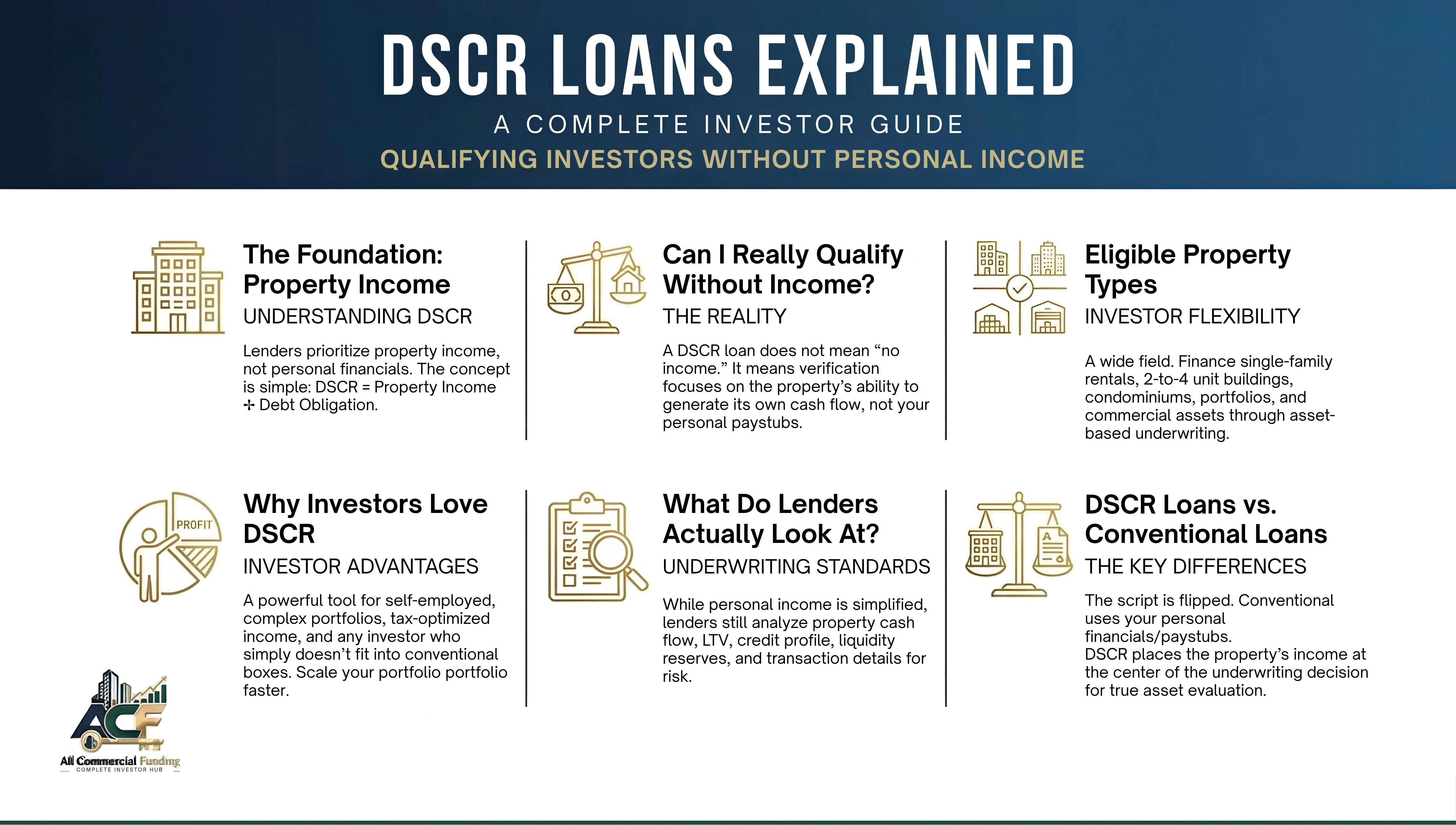
DSCR = Property Income ÷ Debt Obligation
The exact calculation can vary by lender and property type. But the big idea stays the same: the property does the qualifying, not your W-2, your personal debt to income ratio, or a mountain of personal income paperwork.
Can You Really Qualify for a DSCR Loan Without Income?
Let's clear up the confusion.
A DSCR loan doesn't literally mean "no income." It means the lender may qualify the deal primarily on the investment property's income instead of verifying your personal employment income.
That distinction matters.
Traditional consumer mortgage underwriting typically verifies income or assets to establish a borrower's ability to repay. CFPB rules describe several forms of income creditors may consider, including wages, self employment income, investment income, and rental income.
Review CFPB Ability to Repay Requirements
DSCR investment programs flip the script. The property and its ability to produce income sit at the center of the underwriting decision.
For investors whose tax returns don't reflect their true financial strength, that's a game changer.
How Does a DSCR Loan Work?
Picture this. You're buying a rental property, and the lender's DSCR calculation shows $5,000 in qualifying monthly rental income against a $4,000 monthly debt obligation.
$5,000 ÷ $4,000 = 1.25 DSCR
That property produces $1.25 in qualifying income for every $1.00 of debt. That's a property paying its own way, with room to spare.
Here's how to read the numbers. A DSCR above 1.00 means income exceeds the debt obligation. A DSCR of 1.00 means they're roughly equal. A DSCR below 1.00 means the property's income falls short of covering the debt.
But remember: there's no universal DSCR requirement for every lender or every property.
The OCC notes that appropriate DSCR levels should account for factors such as amortization and expected cash flow volatility. A property with predictable long term leases can look very different to a lender than one with unpredictable income.
Why Real Estate Investors Love DSCR Loans
The appeal comes down to one thing:
The financing is built around the property's economics, not your paystub.
That makes DSCR financing a powerful tool for self employed investors, portfolio owners with multiple rentals, borrowers with complicated tax returns or big legitimate deductions, investors who reinvest heavily or have variable income, and anyone who simply doesn't fit neatly into conventional underwriting.
For serious investors, evaluating the deal on the strength of the asset can make the difference between closing and walking away.
What Do DSCR Lenders Actually Look At?
Here's the truth: skipping traditional income qualification doesn't mean skipping underwriting. The lender still needs to know the deal meets its credit and risk standards.
Property cash flow comes first. The lender determines the property's qualifying rental income and whether it supports the loan.
Property value is typically confirmed through an appraisal or other acceptable valuation.
Loan to value shows how much leverage the deal carries.
Your credit profile still counts. It may not be used to verify income, but it can shape your eligibility, pricing, leverage, and reserves.
Liquidity and reserves prove you have the funds to close and a cushion afterward.
Property type matters too, since eligibility and terms vary by asset.
Investment experience may come into play, especially on more complex deals.
Occupancy and use round it out. DSCR programs are designed for investment properties, not your primary residence.
What Is a Good DSCR for an Investment Property?
Everyone wants the magic number. The honest answer? There isn't one that guarantees approval.
Above 1.00, your property income beats the debt. At 1.00, it breaks even. Below 1.00, it falls short. But lenders set their own minimums, calculation methods, pricing adjustments, and exceptions.
The OCC agrees that an appropriate DSCR depends on factors like amortization and cash flow volatility rather than one universal number.
That's precisely why shopping your DSCR deal across multiple lenders pays off.
What Properties Can You Finance With a DSCR Loan?
DSCR financing is built for income producing real estate. Depending on the lender and program, that can include single family rentals, 2 to 4 unit properties, condos, townhomes, rental portfolios, certain short term rentals, and multifamily or other income producing real estate through commercial programs.
Not every lender finances every asset class. Location, occupancy, rental strategy, and property condition can all affect eligibility, which is why matching the property to the right lender matters.
DSCR Loans vs. Conventional Investment Property Loans
The biggest difference? How you qualify.
Conventional financing digs into your personal income, employment, assets, debts, credit history, and debt to income ratio. CFPB regulations governing applicable consumer transactions describe the consideration and verification of income, assets, and debt obligations in determining repayment ability.
DSCR financing puts the property's income front and center.
If you've got strong properties but messy personal financials, that's a major advantage.
To be clear, DSCR isn't automatically cheaper or better than conventional financing. The qualification structure is simply different, and for many investors, it's the one that actually works.
Do DSCR Loans Require Tax Returns?
Often, no. Many DSCR programs don't require personal tax returns for income qualification because approval rests primarily on the property's cash flow.
You'll still need to bring the essentials. Expect to provide identification, entity documents, bank or asset statements, lease and insurance information, property documents, your purchase contract (or existing mortgage details for a refinance), and proof of funds and reserves.
The exact package depends on the lender, property, and deal.
Do DSCR Loans Require a Credit Check?
Generally, yes. This is one of the biggest myths about "no income" investor loans.
No traditional income qualification does not mean no underwriting.
Your credit history can influence your interest rate, leverage, loan amount, reserve requirements, and overall loan structure. Stronger credit usually means stronger terms.
Are DSCR Loan Rates Higher?
They can be. DSCR loans aren't priced like conventional owner occupied mortgages.
Your rate may depend on your DSCR, credit, loan to value, property type, loan amount, prepayment structure, occupancy, transaction type, experience, market conditions, and how hungry the lender is for your kind of deal.
But here's where savvy investors win: don't fixate on the headline rate. Compare the complete financing package. Leverage, prepayment terms, closing costs, cash requirements, amortization, loan term, recourse provisions, and whether the lender can actually close can matter far more than a small difference in rate.
Can You Get a DSCR Loan if the Property Doesn't Cash Flow?
Potentially, but your options narrow.
A DSCR below 1.00 means the property's income doesn't fully cover the debt. Some lenders will pass. Others may allow lower ratios with added requirements, adjusted pricing, more equity, extra reserves, or other compensating factors.
The key point: a weak DSCR with one lender doesn't mean the property can't be financed. It may just need a smarter structure.
How Can You Improve Your DSCR?
DSCR is a simple equation, so you can improve it by boosting income or reducing debt.
Increase qualifying rent. Higher documented rental income strengthens cash flow, as long as it meets the lender's documentation standards.
Put more money down. Borrowing less lowers your debt payment.
Find better loan terms. A different rate or amortization schedule can shrink your debt service.
Cut property expenses. When the calculation uses net operating income, legitimate expense reductions can lift your NOI.
Shop multiple lenders. This one's big. Lenders calculate income and apply criteria differently. A property that barely misses one lender's requirement may fit comfortably with another.
DSCR Loans for Refinancing
DSCR financing isn't just for purchases. Investors also use it to refinance existing properties, whether that means replacing current debt, landing better terms, restructuring the loan, pulling equity out through a cash out refinance, or repositioning a property or entire portfolio.
On a refinance, lenders will look at current value, rental income, existing debt, payment history, requested cash out, and the resulting DSCR.
DSCR Loans for Growing Real Estate Portfolios
Here's the irony of successful investing: the bigger your portfolio gets, the harder conventional qualification can become.
You might hold significant real estate assets and strong rental revenue while showing reduced taxable income thanks to depreciation, expenses, and other legitimate deductions.
DSCR financing cuts through the noise with one question:
Can this investment property support the proposed debt?
For portfolio investors, that opens doors that personal income calculations often keep shut.
DSCR Loan Requirements in 2026
There's no universal rulebook across the DSCR market. But expect lenders to weigh some combination of property income, DSCR, property value, loan to value, credit history, liquidity, reserves, property type, experience, transaction type, and loan amount.
Requirements and pricing can vary dramatically from lender to lender.
Which means who you work with matters as much as the deal itself.
Why Work With a Commercial Mortgage Broker for Your DSCR Loan?
Walk into one lender, and you get one lender's program. One set of rules. One price.
Work with an independent commercial mortgage broker, and you get access to multiple lenders competing for your deal.
At All Commercial Funding, we help real estate investors and commercial property owners find financing that fits the actual transaction. Beyond DSCR financing, we offer access to portfolio loans, bridge loans, hard money, commercial real estate financing, SBA financing for qualifying business transactions, private credit, and both recourse and non recourse structures.
We don't squeeze your deal into one lender's credit box. We find the lender whose box it already fits.
Get Your No Cost DSCR Pre Approval Today
Have an investment property under contract? Eyeing your next acquisition? Ready to refinance?
Start by knowing exactly what financing is available to you.
All Commercial Funding offers a no cost pre approval with no SSN required and no credit pull for the initial pre approval.
Already have financing terms in hand?
Submit your existing term sheet. On most deals, we may be able to get a rate up to 0.25% lower.
Know your options before you commit to a lender.
Start your no cost pre approval with All Commercial Funding today.
Frequently Asked Questions About DSCR Loans
1. Can I get a DSCR loan without showing personal income?
Depending on the lender and program, yes. A DSCR loan may let you qualify primarily using the investment property's cash flow rather than traditional personal employment income. That's why DSCR financing is so popular with self employed borrowers and investors with complex income or tax returns. Other underwriting requirements still apply.
2. What DSCR do I need to qualify for a loan?
There's no universal DSCR requirement. A ratio above 1.00 means qualifying property income exceeds the applicable debt obligation, but each lender sets its own minimums and standards. Property type, credit, leverage, reserves, and other factors can also affect eligibility.
3. Do DSCR loans require tax returns or W-2s?
Many DSCR programs don't require personal tax returns or W-2s to establish income, since the loan is underwritten primarily on property cash flow. Documentation requirements still vary by lender, and borrowers must meet the lender's other underwriting and verification standards.
4. Can a first time real estate investor get a DSCR loan?
Potentially. Some DSCR lenders welcome first time investors, while others have experience requirements or adjust terms based on track record. Credit, reserves, property cash flow, leverage, and the overall deal all play a role.
5. Can I use a DSCR loan to buy a primary residence?
No. DSCR financing is generally intended for business purpose investment properties, not an owner occupied primary residence. If you're buying a home to live in, talk with a qualified lender about the right residential mortgage options.